
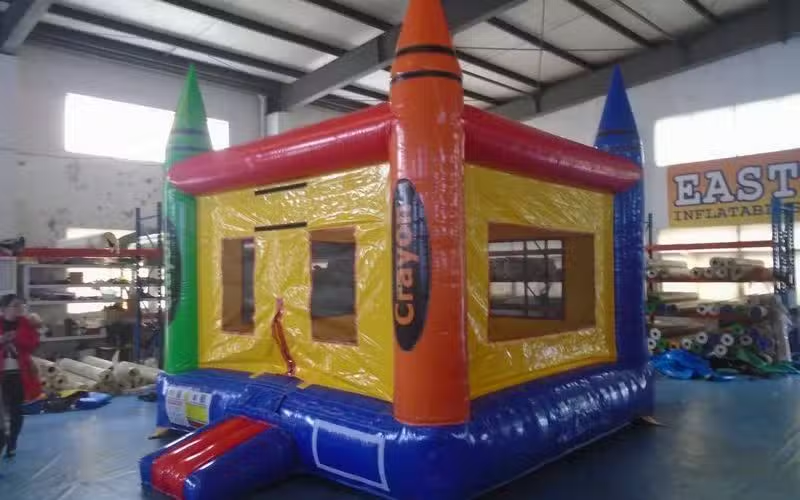
If you’re buying a bounce house for a rental business in the U.S., the “right” unit isn’t the one that looks best in photos—it’s the one that survives weekend after weekend, sets up fast, and keeps you compliant and insurable.
Here are 8 specs that matter most when you’re choosing a bounce house for rentals.
1) Commercial-grade PVC (material weight/thickness)
This is the foundation of durability. Rental units take constant abrasion at the entrance, corners, and high-traffic seams.
What to look for:
- Commercial PVC (often listed by gsm/oz or thickness)
- Reinforced high-wear areas (not just “commercial” as a label)
Why it matters: stronger material resists punctures, stretching, and seam stress over time.
2) Stitching and seam reinforcement
Two bounce houses can use similar PVC and still perform very differently based on how they’re built.
Look for:
- Double stitching on key seams
- Reinforced stress points (corners, entrance, anchor tabs, roof supports if included)
- Quality thread and consistent seam finishing
Why it matters: seams are where rental wear shows up first.
3) Size, footprint, and usable play area
Rentals are about what fits most backyards and venues—while still looking big in photos.
Specs to confirm:
- Overall dimensions (L×W×H)
- Interior jump space (if listed)
- Required clearance and safety buffer
Why it matters: the most bookable size often outperforms the biggest size.
4) Safe entrance design (step height + landing zone)
Entrance stress and trip risk are common issues in rentals.
Look for:
- A stable entrance step
- Clear landing/entry area
- Netting/side walls that guide traffic safely
Why it matters: safer entry reduces incidents and wear at the doorway.
5) Anchoring points (quantity, placement, and strength)
Anchoring is non-negotiable for rentals—wind and movement are real.
Check for:
- Sufficient anchor points around the perimeter
- Reinforced anchor tabs and webbing
- Clear guidance for staking vs sandbagging
Why it matters: better anchoring improves safety and reduces shifting that tears seams.
6) Blower requirements (CFM/HP, number of blowers, power needs)
A bounce house that’s annoying to power is annoying to rent.
Confirm:
- Recommended blower size (and whether it’s included)
- Typical power draw and circuit considerations
- Whether one blower runs the unit properly in real use
Why it matters: power simplicity reduces setup friction and customer complaints.
7) Weight and rolled size (transport + handling)
This decides whether one person can manage the unit or you need a larger crew every time.
Check:
- Unit weight
- Rolled dimensions
- Recommended crew size
Why it matters: handling impacts labor cost, speed, and injury risk.
8) Documentation, labeling, and warranty (rental readiness)
For rentals, paperwork matters more than most first-time buyers expect.
Look for:
- Clear labeling (safety warnings, max occupancy, etc.)
- Manuals and setup guidance
- Warranty terms and how claims/parts are handled
Why it matters: it supports safety practices, customer confidence, and smoother operations.
Quick takeaway
For rentals, the best bounce house spec isn’t one single number—it’s the combination that delivers:
- durability in seams and high-wear zones
- safe traffic flow and strong anchoring
- easy power and fast setup
- transport-friendly handling
- clear documentation and support
Pick a unit that you can deploy reliably every weekend, not one that only looks good on launch day.